School of Computer Science, carnegie Mellon
Site Map Contact Info Directory About SCS Careers Giving to SCS SCS Dean's Advisory Board

News Brief - November 7, 2012

Mitchell, Treuille Featured on NOVA ScienceNOW Nov. 14

The Nov. 14 episode of NOVA ScienceNOW, "What Will the Future Look Like?," featured two Carnegie Mellon research projects: the thought identification research of Tom Mitchell, head of the Machine Learning Department and Marcel Just, professor of psychology, and the work of Adrien Treuille, assistant professor of computer science and robotics, in using games to involve thousands of people in scientific research.

A video of the episode can be viewed here.

The episode includes an extended profile of Treuille, filmed this summer in California where he is spending a leave of absence. It highlights his pioneering work on the Foldit game that enlists people in the intricacies of DNA folding and his latest efforts with EteRNA, his unique research project that taps online game play to explore RNA design. Astro Teller, who earned his Ph.D. in computer science at CMU in 1998 and is now director of new projects for Google, is among the people interviewed about Treuille.

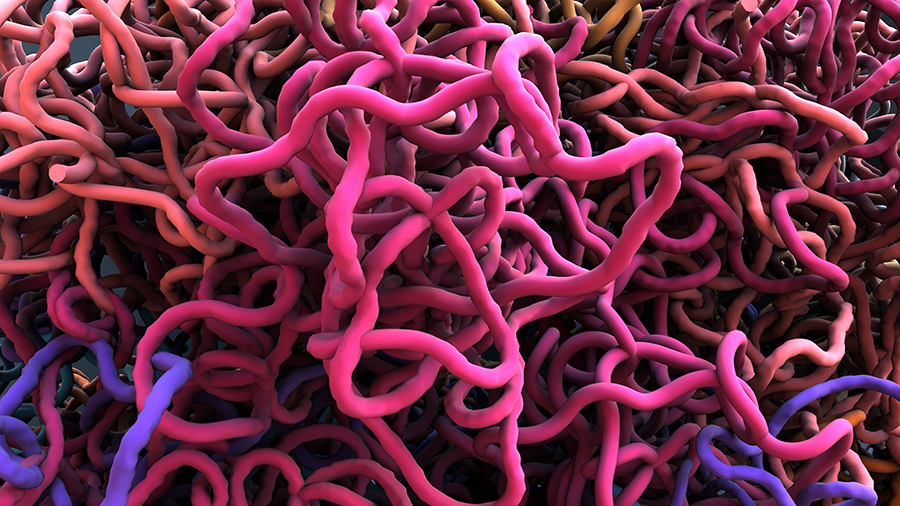
EteRNA was the first online game to tap the wisdom of the crowd to solve wet lab experimental problems. Players use the latest computer modeling programs to create possible solutions to RNA design challenges. The best of their virtual designs are then synthesized in a biochemistry lab at Stanford University and evaluated to see if they work in real life.

Treuille leads the project with Rhiju Das, an assistant professor of biochemistry at Stanford, and Jeehyung Lee, a Carnegie Mellon Ph.D. student in computer science.

The game already has engaged more than 30,000 citizen-scientists in the study of RNA design. Treuille says it has helped identify a number of people, some without formal science training, who display a strong aptitude for RNA design and are generating important scientific insights.

The thought identification work by Mitchell and Just is addressed in a segment of the episode regarding emerging technologies for monitoring brain activity and using thoughts to control technology.

In August, host David Pogue and a production crew visited CMU's Scientific Imaging and Brain Research (SIBR) center to learn more about thought identification research. Mitchell and Just have applied machine-learning techniques to brain imaging data to identify an individual's thoughts of concrete objects. For the episode, Pogue went through the experiment in the center's fMRI scanner on the third floor of Wean Hall.

In the standard experiment, Pogue was shown ten pairs of objects two times while in the fMRI. With the cameras rolling, the brain analysis computer then correctly identified each object that Pogue had been thinking about.

At Pogue's urging, however, Mitchell and Just agreed to run a variation of the experiment: instead of having one computer show an object to Pogue while another identified his thoughts, they allowed Pogue to decide on his own which of two objects to think about in 10 tries. After the experiment, they compared his notes with the computer's analysis.

"We were all nervous about trying this experiment for the first time with the cameras rolling," Mitchell said. "But, we had seen before that our computer model had successfully predicted neural representations for new words, and that these neural representations are remarkably similar across different people."

Happily, the computer correctly identified all ten objects that Pogue thought about.

Follow the School of Computer Science on Twitter @SCSatCMU.

Contact:

Byron Spice
412-268-9068
bspice@cs.cmu.edu

Tom Mitchell, head of the Machine Learning Department; NOVA host David Pogue; and Marcel Just, professor of psychology
NOVA host David Pogue preparing for an fMRI scan.
Adrien Treuille, assistant professor of computer science and robotics
About Carnegie Mellon: Carnegie Mellon is a private research university with a distinctive mix of programs in engineering, computer science, robotics, business, public policy, fine arts and the humanities. More than 10,000 undergraduate and graduate students receive an education characterized by its focus on creating and implementing solutions for real problems, interdisciplinary collaboration, and innovation. A small student-to-faculty ratio provides an opportunity for close interaction between students and professors. While technology is pervasive on its 144-acre Pittsburgh campus, Carnegie Mellon is also distinctive among leading research universities for the world-renowned programs in its College of Fine Arts. A global university, Carnegie Mellon has campuses in Silicon Valley, Calif., and Qatar, and programs in Asia, Australia and Europe. For more, see www.cmu.edu.